
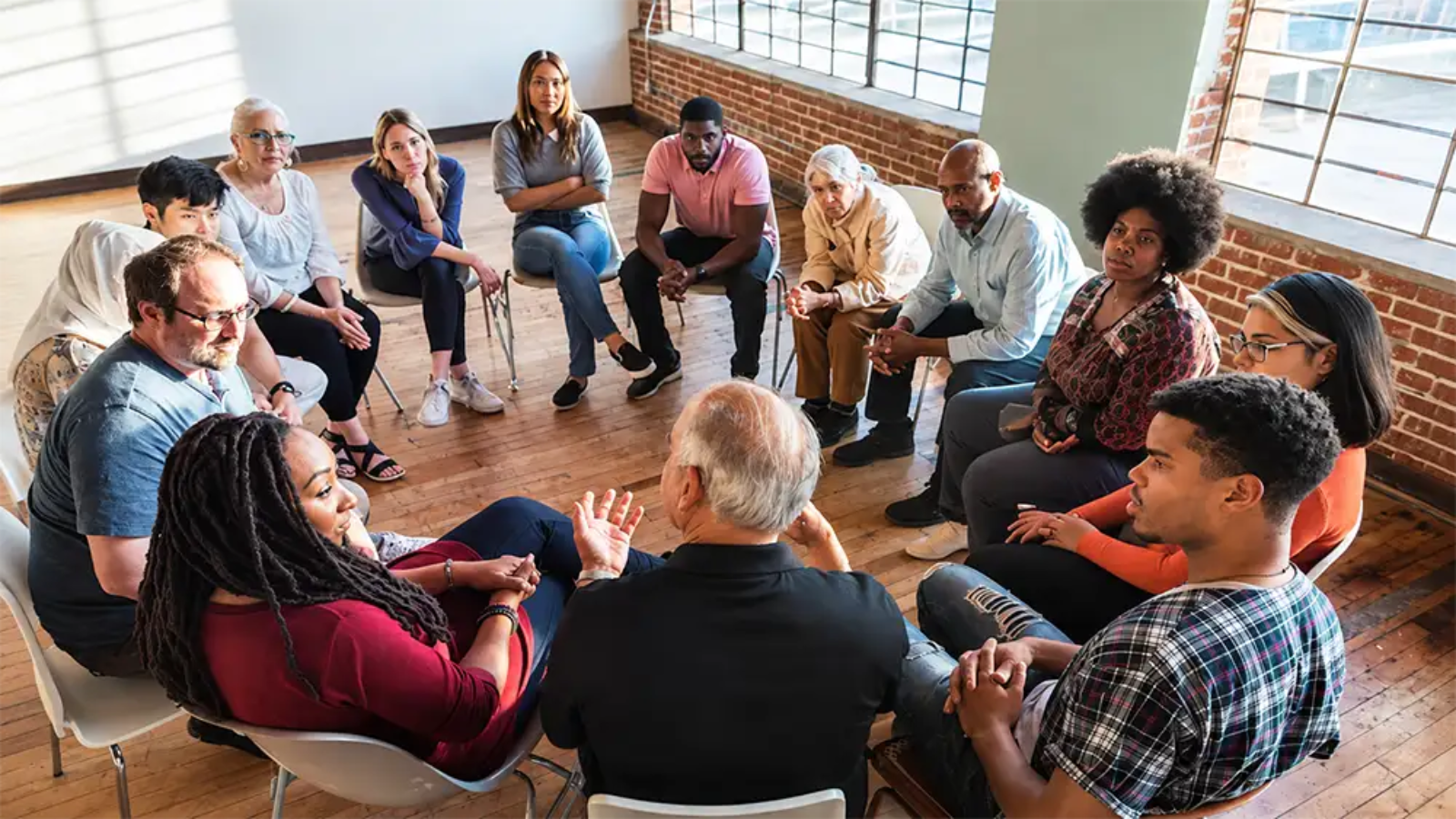
Group Therapy • Clinical Skills • Facilitation Guide
Running your first group can feel very different from sitting across from one client. In individual work, you track one story. In a group, you are tracking six or eight stories at once, plus everything happening between them: who looks away when someone cries, who always speaks first, who has not said a word in three weeks. It can be energizing, and it can be a lot.
So how do you facilitate a group therapy session that people actually want to come back to?
The Short Answer
Good group facilitation starts long before the first session. It comes from careful screening, clear group agreements, and a predictable session structure: a check-in, a focused middle, and an intentional closing. During the session, the facilitator’s main job is not to give answers. It is to keep the room safe enough for members to talk to each other, notice patterns as they show up, and gently redirect when one voice, one conflict, or one silence starts to take over.
Before the First Session: The Groundwork

Most of the problems that show up in week six were set up in week zero. A group that feels chaotic, stuck, or unsafe usually traces back to decisions made before anyone logged on or walked in.
Start with a clear answer to one question: what is this group for? A skills group for panic symptoms, built on Anxiety Therapy techniques, needs a very different setup from an open-ended process group about relationships. When the purpose is fuzzy, members bring fuzzy expectations, and the facilitator spends half the session managing confusion instead of doing the work.
Once the purpose is clear, a few practical decisions follow:
✓ Open or closed? Closed groups keep the same members from start to finish, which helps trust build faster. Open groups let people join over time, which helps with access but means the group is always re-forming a little.
✓ Size. Many clinicians aim for roughly six to ten members. Psychiatrist Irvin Yalom, whose work on group psychotherapy is still widely taught, suggested around seven or eight as a comfortable size for interactive groups.
✓ Length and frequency. Weekly sessions of 75 to 90 minutes are common. Short-term groups often run 8 to 12 weeks.
✓ Co-facilitation. Two facilitators can split the work of tracking content and tracking process, and they model healthy disagreement when they see things differently.
Screening Is Not Optional
A short pre-group interview with each person protects the whole room. It lets you check whether the group fits what this person needs right now, whether they are in acute crisis, and whether anything about their situation could make the group unsafe for them or for others. It also gives the member a chance to meet you before walking into a room full of strangers, which lowers anxiety on day one more than any icebreaker can.
Use the interview to set expectations too. Explain how sessions run, what is asked of members, and what to do if they want to leave the group. People who know what they are signing up for are far more likely to stay.
Write the Group Agreements Together
Agreements work better when members help shape them. Cover the basics: confidentiality, attendance and lateness, how to give feedback, phones and cameras for online groups, and contact between members outside of group. Be honest about one limit in particular: as the facilitator, you are bound by confidentiality, but you cannot guarantee that every member will be. Saying that out loud early builds more trust than pretending the risk does not exist.
A Simple Structure for Every Session
Structure is not the opposite of depth. A predictable rhythm actually makes it easier for members to take emotional risks, because they are not spending energy figuring out what happens next. Here is a format that works for most group therapy settings and can be adjusted for the type of group you run.
Step 1
Open With a Check-In
Give each member a short turn to say how they are arriving today. Keep it brief, a minute or two each, so the check-in does not swallow the session.
Listen for themes. If three people mention feeling overlooked at work this week, that may be where the group wants to go, whether anyone has said so or not.
Step 2
Move Into the Working Phase
This is the middle of the session, where most of the real work happens. In a skills group, it may be teaching and practicing a tool. In a process group, it is the open conversation between members.
Your instinct may be to answer each person yourself. Try turning it back to the room instead: “Has anyone else felt something like that?” Members helping each other is the engine of group work. Yalom called part of this universality, the relief of finding out you are not the only one.
Step 3
Notice the Process, Not Just the Content
Content is what people are talking about. Process is how they are talking to each other. A member might describe feeling ignored by their family while, in that same moment, two other members are talking over them.
Naming that gently, and without blame, is often where the most useful learning happens: “I’m noticing something happening right here in the room. Can we slow down and look at it?”
Step 4
Close With Intention
Leave ten minutes at the end. Ask each member what they are taking with them, or how they are feeling as they leave. Never let a session end in the middle of a raw disclosure with no time to settle.
A steady ending tells members the group can hold hard material and still finish safely, which makes them more willing to bring hard material next week.
Know Where Your Group Is in Its Development
Groups change over time, and a lot of facilitator stress comes from mistaking a normal stage for a failing group. Psychologist Bruce Tuckman’s model, first published in 1965, is still a useful map: forming, storming, norming, and performing, with adjourning added later for the ending.
In the early weeks, members are polite and careful and look to you for direction. Then, often a few weeks in, friction shows up: someone challenges a group rule, pushes back on you, or two members clash. Many new facilitators read this as things falling apart. It is usually the opposite. It means people feel safe enough to stop performing. How you handle this stage teaches the group whether conflict is survivable here. In Men’s Group Therapy, for example, this stage often shows up as competition or teasing before members feel safe enough to say what is actually bothering them.
Conflict in a group is information, not failure.
When members disagree openly and the group stays intact, they experience something many of them have never had: a relationship that survives honesty.
Handling the Hard Moments
Every facilitator runs into the same few situations sooner or later. None of them has a perfect script, but a few principles help.
The member who never talks. Silence is not always resistance. Some people are processing, some are anxious, and some come from families or cultures where speaking up in a group is not the norm, something facilitators in Immigrant Group Therapy see often. Invite without cornering: “You’ve been listening closely today. Anything landing for you?” And accept a pass.
The member who fills every silence. Often this person is anxious too, just in the other direction. Acknowledge what they offered, then open the floor: “Thanks for that. I’d love to hear from someone we haven’t heard from yet.” If the pattern continues, it may be worth exploring with them, kindly and privately, or in the group if it is safe.
Rescuing. When someone becomes tearful, other members may jump in with advice or reassurance right away. It comes from care, but it can cut the feeling short. You can slow it down: “Let’s give her a moment before we respond.”
A safety concern. If a member discloses thoughts of harming themselves or someone else, the group process pauses and clinical responsibility comes first. Have a plan ready before your first session, including how you will follow up one-on-one and what crisis resources, such as the 988 Suicide and Crisis Lifeline, you will share.
A Word From Our Founder
“The best group sessions I have seen were not the ones where the therapist said the smartest thing. They were the ones where a member said something to another member that no therapist could have said as well. Our job is to build a room where that can happen, and then have the patience to get out of the way. At Heartfelt Flourish Psychotherapy, that is what we try to protect in every group we run.”
Hamed Fatahian, Founder, Heartfelt Flourish Psychotherapy
How Facilitation Changes by Group Type
There is no single right way to run every group. Your role shifts depending on what the group is designed to do. This comparison shows how the facilitator’s job changes across common formats.
| Group Type | Facilitator’s Role | Session Structure | Often Used For |
|---|---|---|---|
| Psychoeducational | Teacher and guide; presents information and leads discussion | High; set topics each week | Understanding a condition, stress, or life transition |
| Skills-Based (CBT, DBT) | Coach; teaches tools, assigns practice, reviews progress | High; skill, practice, homework review | Anxiety Therapy groups, panic, emotional regulation |
| Process-Oriented | Observer and guide; names patterns in the here and now | Low; members set the direction | Relationship patterns, identity, connection |
| Specialty / Identity-Based | Culturally aware guide; holds shared experience and individual differences | Medium; loose themes, open sharing | Men’s Group Therapy, Immigrant Group Therapy, shared life experience |
| Peer Support Group | Often a peer, not a licensed clinician; keeps time and agreements | Varies | Ongoing mutual support; not a replacement for therapy |
That last row matters. A support group can be valuable, but it is not the same as group therapy, which is led by a licensed mental health professional who is clinically responsible for the members in the room.
What Shifts in Specialty Groups

Groups built around a shared experience ask a little more of the facilitator. Members arrive with something in common, which speeds up trust, but they also bring assumptions about what everyone else “should” feel.
In Men’s Group Therapy, many members have spent years being told that talking about feelings is weakness. Early sessions often go better with a bit more structure and concrete prompts, such as talking about work, fatherhood, or anger, before moving toward more vulnerable ground. Facilitators in Men’s Group Therapy also tend to see that once one member takes a real risk, others follow quickly.
In Immigrant Group Therapy, cultural humility is a core skill. Members may come from very different countries, carry different relationships with authority figures, and see therapy itself very differently. A good facilitator asks rather than assumes, makes room for the grief and pride that often sit side by side in the immigrant experience, and treats differences inside the group as something to explore, not smooth over. Immigrant Group Therapy works best when members feel they do not have to translate themselves, literally or emotionally, to belong.
For groups focused on anxiety, pacing is everything. A skills-based format drawn from Anxiety Therapy approaches gives members something practical to hold onto, while the group itself becomes a low-stakes place to practice the very thing that feels scary: being seen by others. That is why many Anxiety Therapy groups start with shorter shares and build toward longer ones as members settle in.
Facilitating Group Therapy Online in California
Online groups have made therapy far more reachable for people across California, from someone in a small Central Valley town to a busy parent in the Bay Area who cannot add a commute to their week. They also come with their own facilitation habits:
✓ Use a HIPAA-compliant video platform, and walk members through it before the first session.
✓ Confirm where each member is physically located at the start of every session. Clinicians licensed in California generally need members to be in the state, and you need a location in case of an emergency.
✓ Ask members to join from a private space, with headphones if others are home.
✓ Agree on cameras-on norms, and what to do if someone’s connection drops mid-share.
✓ Make the invisible visible. On screen, you lose body language, so check in more often: “I can’t read the room as well on video. How is this landing for folks?”
Online group work at Heartfelt Flourish Psychotherapy follows this same thinking: the format is different, but the goal of a safe, connected room stays the same.
A useful question after every session is not only “Did I say the right things?”
It may also be: “Did the members talk to each other more than they talked to me?”
HF Psychotherapy
Looking for a group that is already set up to work?
Whether you are a clinician with a client who could benefit from a group, or you are ready to join one yourself, Heartfelt Flourish Psychotherapy offers online group therapy led by licensed therapists for people across California, including Men’s Group Therapy, Immigrant Group Therapy, and group support rooted in Anxiety Therapy.
Frequently Asked Questions
What does a group therapy facilitator actually do?
A facilitator screens members, sets up the group agreements, guides each session’s structure, and keeps the room emotionally safe. During sessions, much of the work involves encouraging members to respond to one another, pointing out patterns as they happen, and stepping in when conflict, silence, or one person’s needs start to take over the group.
How do you start the first group therapy session?
Begin with introductions, a clear explanation of the group’s purpose, and a review of the group agreements, especially confidentiality and its limits. Many facilitators then use a simple, low-pressure prompt, such as what brought each person to the group, so everyone speaks once early on without being pushed to share more than they are ready to.
What is the difference between a group therapist and a support group leader?
A group therapist is a licensed mental health professional who is clinically responsible for the members, uses therapeutic methods, and can assess risk. A support group leader is often a trained peer who keeps the group organized and supportive. Both can be helpful, but they serve different purposes.
What kinds of group therapy does Heartfelt Flourish Psychotherapy offer?
Heartfelt Flourish Psychotherapy runs online group therapy for adults across California. Current groups include Men’s Group Therapy for men working through stress, anger, relationships, or isolation, Immigrant Group Therapy for people adjusting to life between two cultures, and groups that draw on Anxiety Therapy skills for worry and panic. Each group is led by a licensed therapist and starts with a short screening call to make sure it is a good fit.
Can group therapy work as well online as in person?
For many people, yes. Online groups require extra attention to privacy, technology, and emergency planning, and facilitators need to check in more often because body language is harder to read. With those pieces in place, online groups can build real connection and make therapy accessible to people who could not attend in person.
If you are curious what a well-run group feels like from the member’s side of the screen, take a look at our online group therapy in California and the different groups we currently offer, or learn more about Heartfelt Flourish Psychotherapy and our team.
Educational Note: This article is intended for general educational purposes and is not a substitute for clinical supervision, professional training, individualized mental health care, or crisis support. If you or someone you know is in crisis, call or text 988 in the United States.
Add a Comment